September 3, 2026
Gold-Winning UX: Empowering Scientists, Enabling Scale
How LINQ turns scientific intent into reusable workflows, confident execution and greater throughput.
Good design in lab automation does more than make software easier to use. It can reduce training demands, prevent costly errors and help teams scale lab operations more effectively. That’s why we’ve designed LINQ around the people using it, not just the engineering behind it.
Lab automation software has long carried the feel of an earlier era: unforgiving interfaces, blocks of code, and workflows understandable only to those who built them. Engineering first, usability an afterthought. The result? A field where only specialists can operate the tools and ultimately where the tools, not the science, set the limits.
We studied the problems scientists face automating lab work, and applied thoughtful design to solve them. Among more than 500 entries from 46 countries, LINQ won Gold in the UX Design Awards. It’s a recognition that we’re proud of, but more importantly, it’s proof that when automation is easier to learn, safer to run and simpler to scale, science moves faster.

A deeper dive: how we designed for excellence
Every decision within LINQ is grounded in research with scientists and automation specialists across Europe and the US. We investigated how they think through experiments and where existing tools fall short.
From that research came three design principles: approachable, speaking the language of the lab; empowering, enabling scientists to work with greater confidence and control; and pure, making complex automation feel simple.
Here’s what those principles look like in practice:
Focus on thinking like a scientist
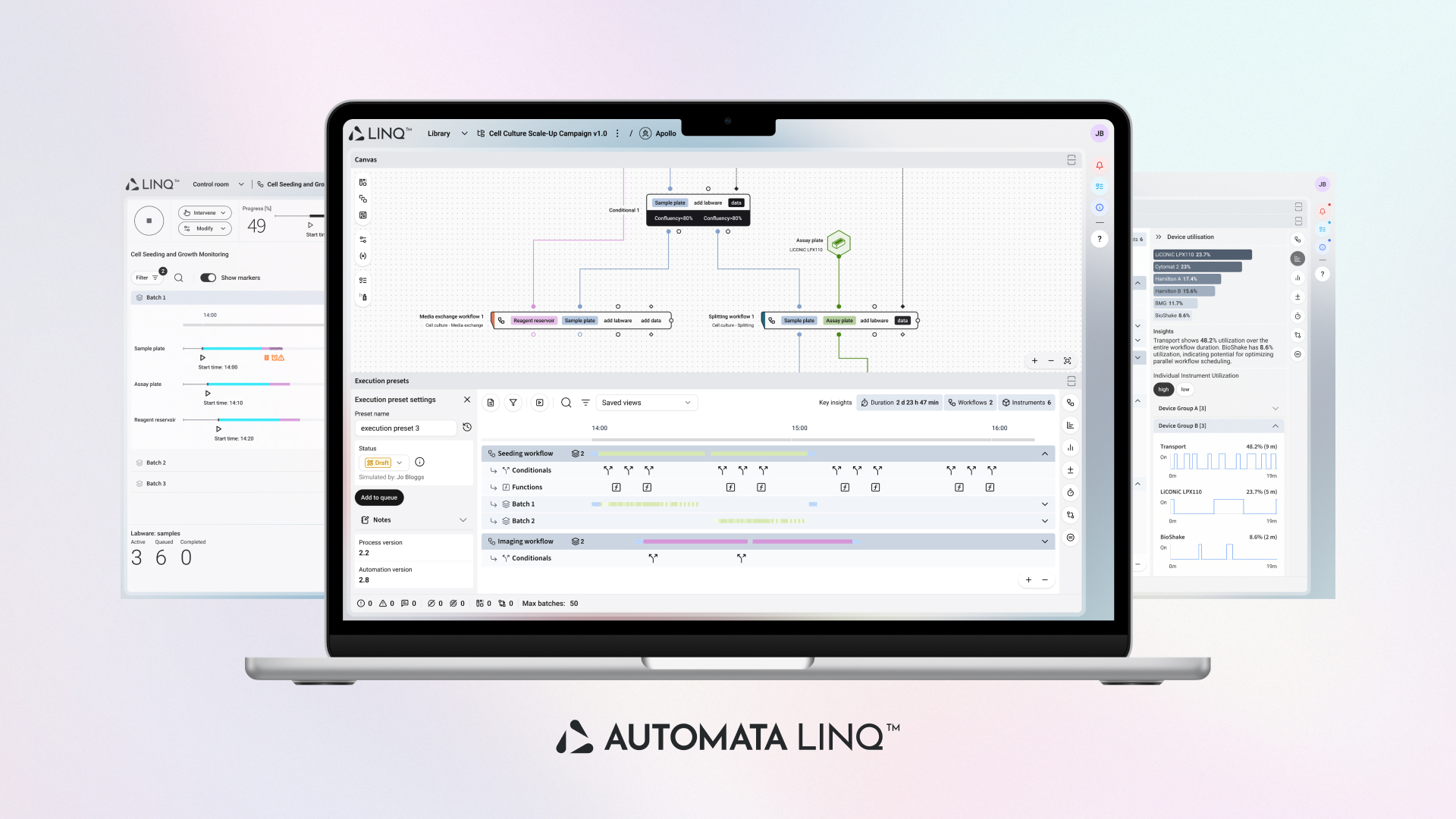
Most automation software comes with a steep learning curve, requiring scientists to think like programmers and coordinate sequences, timing and dependencies themselves. LINQ removes that specialist knowledge barrier. Scientists define their intent and constraints through a no-code interface with clear, at-a-glance guidance, while experts retain finer control when they need it. New users can become productive sooner, reducing training demands and freeing scientists to focus on work that requires their expertise.
Build once, reuse and scale
Research teams may move between setups, sites and equipment configurations, often requiring workflows to be rebuilt for even a simple instrument upgrade. Once designed, LINQ workflows can run across different instruments and environments without being rebuilt from scratch. This reduces the time and specialist effort required to make changes, improves consistency across teams and sites, and supports the sharing and reuse of scientific knowledge.
Catch the mistake before it costs you a sample
Failed runs carry real cost: wasted reagents, lost or damaged samples, inconsistent data and delayed results. Rather than waiting for failure to recover from it, LINQ prioritizes prevention. Built-in simulation allows scientists to test and validate workflows before committing to physical runs against real samples, surfacing conflicts and errors early and reducing user-driven errors. This can shorten the time it takes to validate a workflow, reduce the associated costs, and increase confidence that it will execute consistently and reproducibly.
Increase throughput without increasing oversight
Coordinating timing, sequencing and instrument availability traditionally requires significant effort and constant oversight. LINQ handles that coordination, continuously optimizing execution and adapting as conditions change. Live monitoring shows runs updating in real time, with warnings and deviations flagged as they happen. Teams can run more experiments with less manual supervision, while staying informed and in control.
Simplify to the essential, manage by exception
Automation software often surfaces raw technical complexity, leaving users overwhelmed and unsure what requires action. LINQ keeps routine execution in the background and directs attention to what matters. Users can see the state of their lab and helpful insights at a glance, access detail on demand and see issues flagged only when they require judgment or intervention. This supports better-informed decision-making and helps the same-sized team use its capacity more effectively.
The impact in numbers
Labs using LINQ have achieved up to five times greater throughput and reduced manual intervention by as much as 95%.
These figures reflect more than product performance, they show the impact of designing intentionally for the end user. Making workflows easier to create, configure, and operate translates into tangible value for scientific organizations: less time spent operating and supervising automation, more capacity from existing teams and equipment, and greater consistency across runs.
Complex workflows that once required constant oversight can now run unattended overnight. In fields such as drug discovery and cancer research, that additional capacity can reduce the time needed to reach outcomes, helping teams move toward meaningful discoveries sooner.
Gold: a milestone toward a bigger transformation
Good design in lab automation is not a finishing touch. It determines who can participate in scientific work and how much of it gets done. This award reflects progress, but it is not a conclusion.
LINQ's foundations are already built for what comes next.
Structuring workflows around scientific intent and standardized steps does more than make LINQ easier to use today. It creates a machine-readable model of how a lab actually operates. This provides a foundation for an AI-enabled future that includes generative workflow creation, predictive scheduling, anomaly detection and labs that don't just automate, but adapt on their own.
A future of faster, greater scientific discovery is within reach.
Explore how LINQ can increase throughput, reduce intervention and scale automation with confidence.