AI x BIO Tech Talks Recap: What It Takes to Build AI-Native Labs

During Boston Tech Week by a16z, Automata opened the doors to its Cambridge HQ for AIxBIO Tech Talks: The Infrastructure Behind AI-Native Labs.
Across an afternoon of fireside chats, panel discussions, open lab access, and curated networking, leaders from NVIDIA, Ginkgo Bioworks, E Tech Group, Automata, and the wider AI × Bio ecosystem came together to explore one of the biggest questions facing the industry:
What does it actually take to make AI work in biology at scale?
The answer that emerged throughout the day was clear: AI-native biology will not be built by models alone. It will require connected infrastructure, contextualized data, intelligent orchestration, and lab environments designed to close the loop between compute and experimentation.
More importantly, the conversation has shifted.
The industry is moving beyond the idea of AI as simply a model problem and toward a much more operational reality: how to build laboratories capable of supporting continuous, intelligent scientific execution.
From Lab Automation to Scientific Acceleration
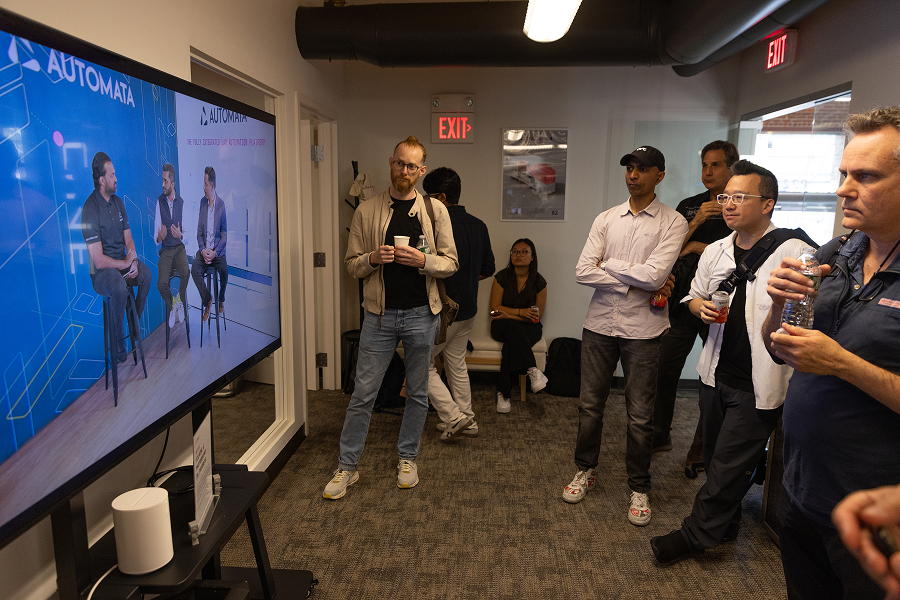
The first fireside chat, Selling Science: The Commercial Reality of Intelligent Lab Automation, focused on the shift from automation as a technical capability to automation as infrastructure for scientific outcomes.
Featuring leaders from Automata and NVIDIA, the session explored how AI-native labs require more than isolated robotics systems or incremental throughput gains. The larger opportunity lies in creating connected environments where experimentation, data generation, and decision-making can move together faster.
One idea stood out early in the conversation:
“Lab automation is not the goal. Scientific acceleration is.”
Bryan Dsouza, Head of Marketing, Automata
That distinction shaped much of the discussion throughout the day. Automation is increasingly being evaluated not by how many manual steps it removes, but by how effectively it accelerates scientific iteration, improves data quality, and enables teams to move from hypothesis to validation faster.
The discussion also highlighted the growing importance of “lab-in-the-loop” infrastructure, where computational systems and physical experimentation operate as part of the same feedback cycle. As AI models become more capable, the limiting factor becomes the laboratory’s ability to operationalize those insights in real-world workflows.
Many of these themes were explored in greater depth during the fireside discussion, including the commercial realities of intelligent automation and the growing need to connect AI with experimental execution. Watch the full session here.
AI Is Becoming an Infrastructure Challenge
The second fireside chat, Building Tomorrow’s Lab Today: The Product Bets That Matter, focused on the operational foundations required to support AI-native labs.
Throughout the conversation, one message surfaced repeatedly:
“AI is only as powerful as the systems and data underneath it.”
Aniket Deshpande, Global Business Development Lead, NVIDIA
As organizations accelerate AI adoption across drug discovery and laboratory operations, the conversation is rapidly shifting beyond models and into the infrastructure supporting them: orchestration, interoperability, metadata, traceability, workflow design, and execution reliability.
Disconnected systems create disconnected outcomes.
AI cannot generate reliable scientific insight if the workflows producing the underlying data are fragmented, poorly contextualized, or operationally inconsistent. This is a challenge we explored in more depth in Why Your Lab Automation Stack Wasn't Built for AI (And What to Do About It), which looks at why traditional automation architectures often struggle to support AI-native workflows.
This is where orchestration becomes critical.
Modern labs are increasingly composed of dozens of instruments, software environments, automation systems, and workflows operating simultaneously. The challenge is no longer simply automating individual tasks. It is creating environments where systems can coordinate, exchange context, and operate as one connected workflow.
The session also reinforced why orchestration platforms like LINQ are becoming strategically important. The future of AI-native labs depends not only on automation hardware, but on the operational layer connecting workflows, systems, and data into a unified environment.
Closing the Loop Between AI and Experimentation
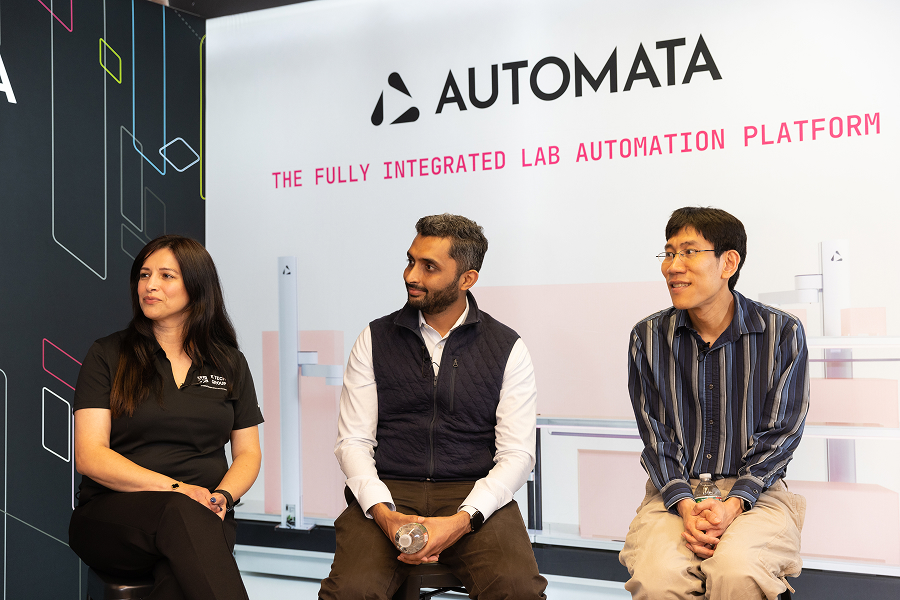
The closing panel discussion, The Automated Lab: Where Intelligent Automation Is Winning Right Now, brought together leaders from NVIDIA, Ginkgo Bioworks, E Tech Group, and Automata to discuss where intelligent automation is already creating measurable impact.
One of the strongest themes throughout the session was the concept of “lab-in-the-loop” infrastructure: connecting AI-generated hypotheses directly into experimental execution and continuously feeding the resulting data back into the system.
As the panel discussed:
“The future depends on closing the loop between in silico design and wet lab execution.”
Aniket Deshpande, Global Business Development Lead, NVIDIA
That loop is becoming increasingly important as organizations move beyond isolated AI tools and toward continuous experimentation systems capable of accelerating scientific discovery.
The panel explored how autonomous labs, orchestration systems, and AI agents are beginning to compress the cycle between design, execution, analysis, and optimization. But speakers were equally clear that operationalizing these systems remains difficult.
One of the largest barriers is the complexity of biological data itself.
Biology produces highly variable, multimodal datasets that often lack the metadata and contextual information required for AI systems to reason effectively across experiments. Capturing not only experimental outputs, but also the conditions and operational context behind those outputs, is becoming increasingly critical.
That challenge is reinforcing the need for unified laboratory data environments, where workflows, instrumentation, execution context, and experimental outputs operate as part of the same connected system. As discussed in Future-Proofing Lab Automation: How Unified Data Unlocks AI-Driven Workflows, unified data architecture is quickly becoming foundational for AI-native labs.
Another major challenge is orchestration.
As Sura Hadi from E Tech Group explained:
“The robot is usually fine. It’s the orchestration behind it that fails.”
Sura Hadi, Director of Laboratory Automation & Industrial Robotics, E Tech Group
That point resonated strongly throughout the event. Many laboratories already have automated components in place. The harder challenge is coordinating workflows, protocols, software systems, and data pipelines in a way that enables reliable scientific execution at scale.
The panel also explored how AI interfaces themselves may evolve over time. As AI systems become increasingly context-aware and autonomous, the interface between scientists and systems may begin to fade into the workflow itself.
Austin Che from Ginkgo Bioworks described that future simply:
“When there is no interface, that’s the best interface.”
Austin Che, Co-Founder, Ginkgo Bioworks
The full panel discussion expands on these ideas in much greater detail, covering autonomous experimentation, unified data environments, orchestration, and the future of AI-native biology. Access the recording on demand.
What AI-Native Labs Actually Require
Across all three sessions, one message became increasingly clear: the industry is moving beyond experimentation with AI and toward operationalizing AI-native science.
That means solving for:
Connected Workflows
Labs need environments where instruments, automation systems, software platforms, and scientists can operate within the same workflow rather than across disconnected handoffs and siloed processes.
Contextualized Data
AI systems require more than experimental outputs. They require metadata, execution parameters, operational traceability, and scientific context in order to interpret results reliably and generate meaningful downstream recommendations.
Orchestration Across Systems
As laboratories become increasingly complex, orchestration becomes the connective layer between instruments, software, workflows, scheduling, and experimental execution.
Governance and Traceability
AI-native labs must also be deployable within real-world operational and regulated environments. That requires reproducibility, provenance, auditability, and reliable workflow governance.
Scalable Experimentation Infrastructure
The next generation of labs must support higher-throughput experimentation, faster iteration cycles, and increasingly autonomous forms of scientific execution.
Faster Feedback Loops Between Compute and Biology
The long-term opportunity lies in enabling computational systems and experimental infrastructure to continuously inform one another in near real time, accelerating the cycle between hypothesis, execution, and optimization.
For biotech organizations, this shift has the potential to fundamentally reshape how discovery infrastructure is designed and operated.
The organizations moving fastest are increasingly thinking beyond standalone automation and toward connected environments where AI, orchestration, experimentation, and data generation operate as part of the same system.
At Automata, this is the direction we are building toward with LINQ: enabling labs to connect automation, orchestration, software, and data into a more intelligent operational foundation for scientific discovery.
Final Thoughts
AIxBIO Tech Talks brought together founders, scientists, automation engineers, operators, and investors actively shaping the future of AI-native biology.
The conversations throughout the day moved beyond hype and into the operational realities of intelligent automation: infrastructure, interoperability, orchestration, data quality, adoption, and scientific outcomes.
The future of AI in biology will not be built through isolated tools or disconnected workflows.
It will be built through connected systems capable of linking AI, automation, experimentation, and data into one continuous scientific engine.
Thank you to everyone who joined us at Automata HQ during Boston Tech Week, and to our speakers from NVIDIA, Ginkgo Bioworks, E Tech Group, and Automata for helping push the conversation forward.
Photography and videography for AIxBIO Tech Talks were provided by Penzy Films, whose work helped capture the conversations, energy, and community that made the event possible.
Watch the Sessions On Demand
Want to revisit the discussions?
Access the full recordings from AIxBIO Tech Talks, featuring speakers from NVIDIA, Ginkgo Bioworks, E Tech Group, and Automata exploring AI-native labs, intelligent automation, orchestration, and the future of scientific discovery.